Products Mentioned in this Review
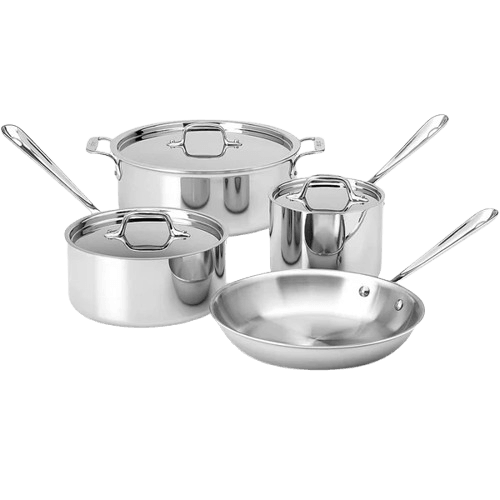
All-Clad D3 Stainless
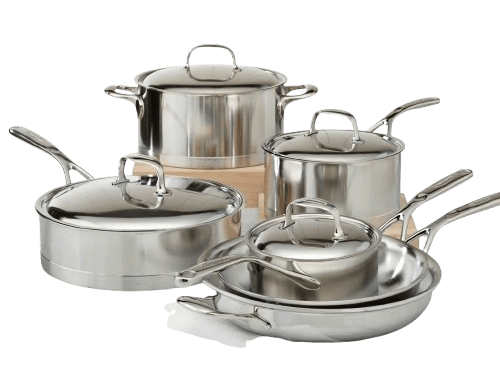
Demeyere Atlantis
Heritage Steel Titanium Series
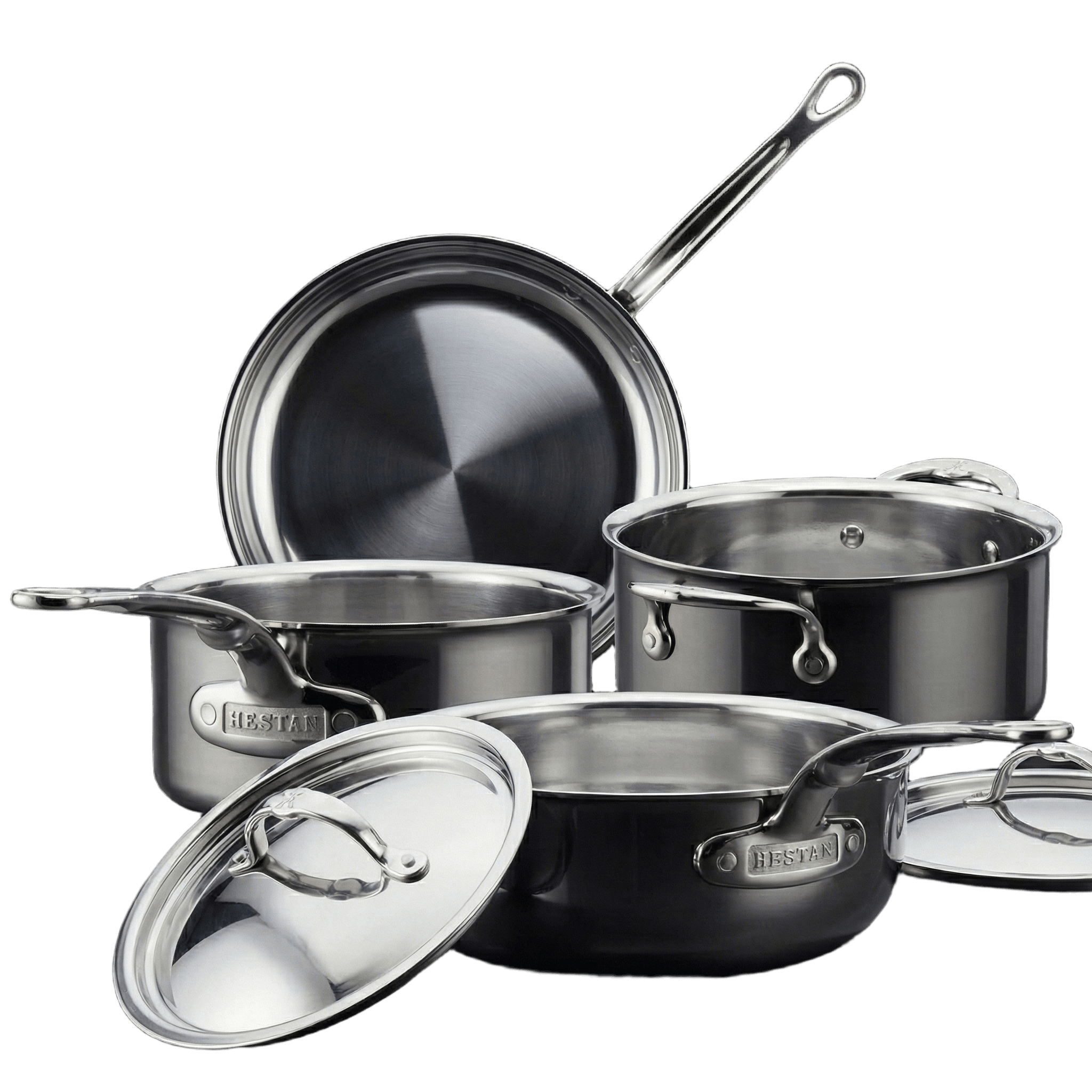
Hestan NanoBond Catalog
The Anatomy of Generational Cookware: What Actually Matters
Before you drop $2,000 on a gleaming set of stainless steel, it pays to understand the engineering beneath the polish. A heavy price tag doesn't automatically guarantee durability if the pan isn't designed for how you actually cook. Here is exactly what separates "good enough" cookware from truly generational cookware.
Thermal Mass vs. Responsivenes
In the world of stainless steel, you're constantly trading off between thermal mass (heat retention) and responsiveness (how fast a pan reacts to temperature changes). Classic 3-ply pans (like the All-Clad D3) are relatively thin. They heat up instantly and cool down instantly when you drop a cold steak into them.
True generational cookware, however, leans toward higher thermal mass. Pans built with 5-ply, 7-ply, or specialized copper/thick aluminum bases hold onto heat aggressively. When you drop a cold protein into a heavy pan, the temperature of the cooking surface won't plummet, giving you a beautiful, restaurant-quality crust. Newer gimmicks, like graphite cores, might brag about extreme responsiveness, but they often fail at high-heat searing precisely because they lack this necessary thermal mass.
Quality of Life Upgrades: Rivets and Pouring Lips
Look inside your current skillet right now. Do you see two round rivets holding the handle in place? Those rivets are absolute magnets for baked-on grease, burnt oil, and carbon buildup. Cleaning around them usually requires a toothbrush and infinite patience. Premium European brands have shifted to welded handles, leaving the interior cooking surface completely smooth and frictionless to clean. Alternatively, brands like Hestan use "flush rivets" that are pressed completely flat against the steel.
Also, a skillet without a flared pouring lip will predictably dribble hot oil down the side of the pan and onto your stove every time you try to empty it. Generational cookware must feature a meticulously engineered, flared rim for clean pouring.
The Handle Ergonomics Reality
A skillet's handle is your only physical interface with the tool. All-Clad is famous for its "U-shaped" handle, originally designed to prevent the pan from rotating in a professional chef's towel-wrapped hand. For the average home cook, however, we found it digs painfully into the palm. Modern competitors have invested heavily in ergonomic, hollow-cast handles that stay cool on the stove and comfortably disperse the immense weight of 5-ply steel across your grip.
The 2026 Dishwasher Reality: Surviving the Modern Kitchen
Let's address the elephant in the room: in 2026, very few of us have the time to meticulously hand-wash and dry every single pot and pan after a busy Tuesday night dinner. If you're spending premium money on a "Buy It For Life" pan, it needs to survive the realities of your household—and that means surviving the dishwasher.
This exposes the dirty secret of the luxury cookware industry: The Exposed Edge.
Traditional clad pans (including classic All-Clad) are cut from large sheets of metal, leaving the interior aluminum core exposed at the very rim of the pan. Modern dishwasher detergents rely heavily on powerful enzymes and harsh alkalines to strip away baked-on food. Over the years, these caustic detergents literally eat away at the exposed aluminum core on the rim of the pan. The result? The exterior stainless steel layers peel back, creating razor-sharp edges that are waiting to slice your hands open when you reach into the cupboard.
If you're buying a pan for life, you must account for human error and convenience. The best modern pans feature "sealed rims"—where the stainless steel is rolled or welded completely over the aluminum core, encapsulating it forever.
The Best BIFL Brands for the Dishwasher:
- Hestan (NanoBond & ProBond): Hestan uses perfectly sealed rims. Furthermore, the NanoBond's titanium surface is so hard that the abrasive nature of standard dishwasher detergent won't dull its mirror finish over time.
- Demeyere (Atlantis & Industry): Demeyere seals the edges on all their fully-clad pieces. Their proprietary Silvinox finish also prevents the dull, chalky oxidation that typically plagues cheaper stainless steel after repeated dishwasher cycles.
- Fissler (Original Profi): Because Fissler uses a massive encapsulated base welded to a solid stainless steel body (rather than clad walls), there is no exposed aluminum anywhere on the pan. It is practically indestructible in a dishwasher.
All-Clad D3 - The Legacy Benchmark
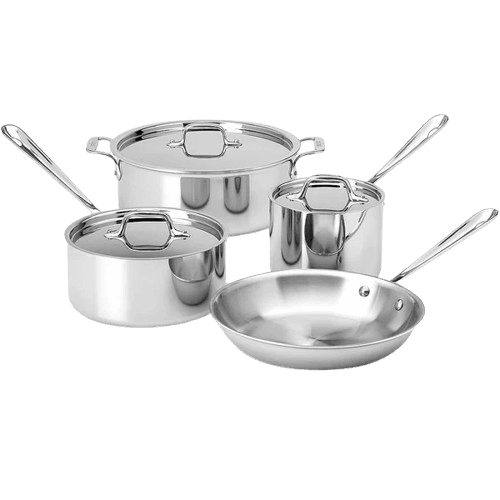
All-Clad D3 Stainless
The All-Clad D3 is the industry standard against which all other pans are judged. Manufactured in Pennsylvania, it utilizes a classic 3-ply construction (stainless-aluminum-stainless). It is the pan that built the premium stainless market, but resting on its laurels has allowed competitors to catch up.
The Engineering: The D3 is the undisputed king of responsiveness. Because it is thinner and lighter than European 5-ply or 7-ply pans, it reacts to heat adjustments on a gas stove almost instantly. If a delicate pan sauce or a beurre blanc is about to break, turning down the dial drops the pan's temperature immediately, potentially saving your dinner. Think of it as the agile, nimble sports car of the kitchen, giving you incredible control over temperature-sensitive dishes.
The Reality Check: The D3 shows its age in the finer details. It still uses exposed rims, meaning it is strictly hand-wash only if you want it to survive decades without that aluminum core receding and becoming sharp. The prominent interior rivets are an absolute pain to clean, constantly trapping scorched oil. Furthermore, the steep, straight sidewalls on the skillets lack a flared pouring lip, making pan-sauce transfers unnecessarily messy.
Finally, the notorious U-shaped handle remains polarizing. It offers incredible leverage for a professional line cook grabbing the pan with a thick side towel, but for a home cook operating bare-handed, it can dig painfully into the palm. You will either learn to adapt to it, or you will absolutely loathe it.
Demeyere Atlantis - The Flawless Titan
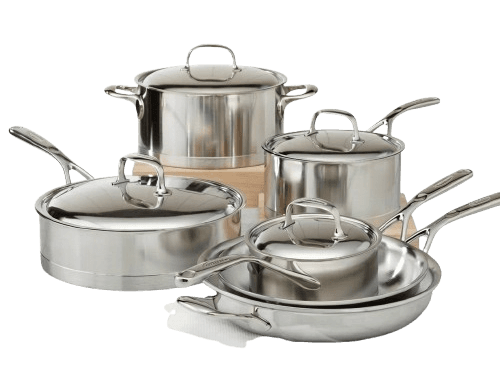
Demeyere Atlantis
If All-Clad is an agile sports car, Demeyere Atlantis serves as the heavily armored tank. Manufactured in Belgium, Demeyere approaches cookware with an almost absurd level of over-engineering, solving virtually every complaint aimed at traditional clad pans.
The Engineering: Demeyere doesn't use a lazy, one-size-fits-all cladding approach. Their straight-sided pots (like saucepans and stockpots) use a 7-layer "InductoSeal" base featuring a 2mm copper disk hermetically sealed into the bottom for flawless, edge-to-edge heat distribution. Their skillets (often branded as Proline) are fully clad 7-ply with a massive 3.7mm thickness. This gives them thermal mass that genuinely rivals rough cast iron. When you drop a massive ribeye into this skillet, the pan doesn't flinch—the temperature remains violently hot, ensuring a perfect crust.
Furthermore, Demeyere uses a proprietary "Silvinox" electrochemical treatment. This process removes surface iron and impurities, resulting in a silvery-white finish that resists heat-tinting, fingerprints, and sticky proteins far better than standard steel.
The Reality Check: The Atlantis line fixes every one of All-Clad's flaws. The handles are perfectly welded (zero rivets inside the pan), the rims are sealed and flared for drip-free pouring, and the pans are completely dishwasher safe. However, the physical constraint here is extreme weight. A 12-inch Atlantis skillet is incredibly heavy. Tossing vegetables or flipping a heavy omelet with one hand requires serious wrist strength. But if you cook on an induction stove—where heavy mass is strictly required to prevent the annoying magnetic "buzzing" common in thinner pans—this is the absolute pinnacle of cookware.
Heritage Steel (Titanium Series) - The Ergonomic American
Heritage Steel Titanium Series
Heritage Steel, manufactured in a family-owned factory in Clarksville, Tennessee, is the brand that quietly fixed the American stainless steel skillet. Their flagship Titanium Series is built for those who want USA-made quality without the ergonomic drawbacks of older legacy brands.
The Engineering: The standout innovation here is metallurgical. While almost all competitors use standard 18/10 (304) stainless steel for the cooking surface, Heritage Steel's Titanium Series utilizes 316Ti stainless steel—an advanced alloy stabilized with titanium. This upgrade makes the cooking surface up to 20 times more resistant to salt pitting and acidic corrosion. If you regularly boil heavily salted pasta water or reduce highly acidic tomato sauces and wines, this surface will remain pristine and pit-free decades longer than standard steel.
The Reality Check: Heritage Steel utilizes a 5-ply construction that strikes a beautiful, highly practical balance—it retains heat significantly better than the D3, but remains much lighter and easier to maneuver than the hulking Demeyere Atlantis. They also entirely solved the handle problem. Heritage utilizes a smooth, hollow, stay-cool ergonomic handle that fills the palm and is a genuine joy to hold.
However, they aren't completely flawless. Some users find the handle too smooth, occasionally allowing the pan to rotate slightly in the hand when pouring heavy liquids. Additionally, while the 316Ti steel is incredibly durable, it can take slightly longer to heat up than pure 3-ply aluminum competitors.
Hestan NanoBond - The Indestructible Innovator
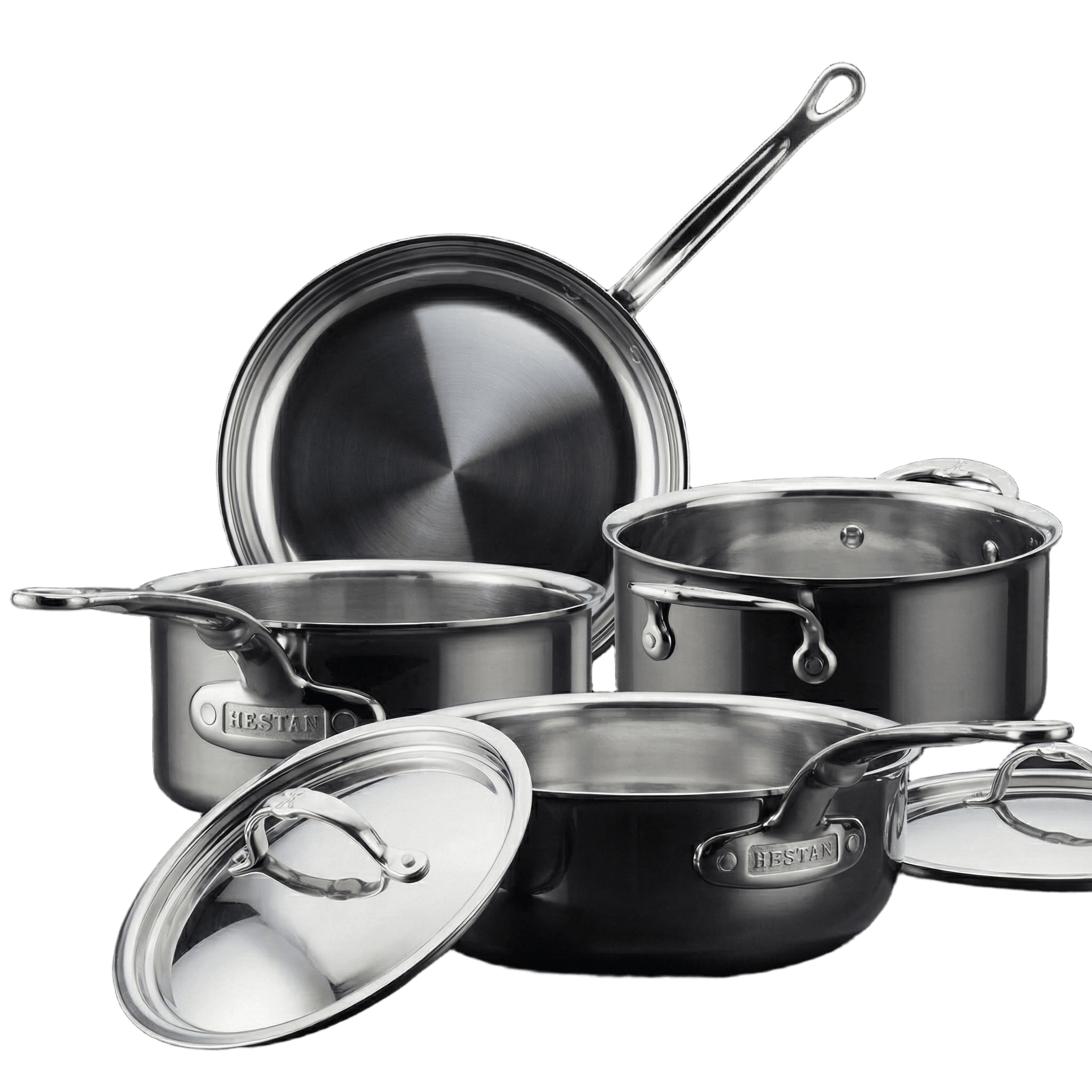
Hestan NanoBond Catalog
Hestan represents the bleeding edge of modern cookware technology. Manufactured in Italy, the NanoBond series looks like dark, gunmetal chrome and promises a level of durability that borders on science fiction. It's designed for cooks who want premium performance but refuse to baby their equipment.
The Engineering: Hestan uses a patented process inside a vacuum chamber to bond thousands of titanium nano-layers directly into the stainless steel surface. The result is a cooking surface that is 400% harder than typical stainless steel. It is virtually scratch-proof. You can aggressively take a metal whisk, a metal spatula, or even an immersion blender directly to the surface of this pan without leaving a single scuff mark.
It is built around a thick "ProCore" pure aluminum center that pushes heat to the edges 35% faster than standard cladding. Furthermore, it boasts an apocalyptic heat tolerance of 1,050°F. This means you can pull it off the stove and throw it directly onto a blazing outdoor charcoal grill or under a commercial salamander broiler without warping it.
The Reality Check: Hestan nailed the quality-of-life details. It features sealed rims (rendering it 100% dishwasher safe) and brilliantly engineered flush rivets. The rivets are pressed completely flat against the interior steel, preventing any gunk or carbon buildup while retaining the mechanical strength of a riveted joint.
The only true drawback is the ultra-premium price tag. Outfitting a whole kitchen in NanoBond requires a formidable budget. Additionally, the dark gunmetal finish shows water spots easily if not dried promptly, though a quick wipe usually restores its mirror shine.
The "Non-Stick" Transition:
The biggest reason people abandon their expensive BIFL stainless steel and revert to toxic Teflon pans is because their food sticks violently to the surface. Let's clear this up: stainless steel requires a specific technique. The pan isn't defective; you're just using it wrong.
To cook eggs, fish, or delicate proteins on stainless steel without sticking, you must preheat the pan properly to leverage the Leidenfrost Effect.
- 1. Place the dry pan on medium heat for 2 to 3 minutes.
- 2. Add a few drops of water to the pan.
- 3. If the water sizzles and boils off immediately, the pan is still too cold.
- 4. If the water forms a single, cohesive bead that dances and glides across the surface like liquid mercury, your pan is perfectly heated.
- 5. Now add your oil, let it heat for 10 seconds, and add your food. The moisture in the food will instantly vaporize, creating a microscopic layer of steam that prevents the proteins from binding to the steel.