The problem BlackVue finally solved
BlackVue has been building cloud-connected dash cams since 2013. Their cloud platform, now running on Amazon Web Services, is the most mature in the consumer dash cam market — Live View, GPS tracking, two-way voice, push notifications, automatic event upload. The problem, consistently noted by independent testers including Vortex Radar, has been video quality. For years, BlackVue cameras recorded footage that was adequate but clearly behind the best Viofo cameras in night clarity, color accuracy, and dynamic range. Drivers who wanted both good cloud connectivity and good footage quality ran two cameras: a BlackVue for the cloud and a Viofo for the footage.
The Elite 9-2CH, released in November 2025 and tested extensively through early 2026, changes this. Vortex Radar, who has been testing dash cams since 2012 and had been one of the clearest voices about the previous generation's video quality limitations, wrote in December 2025 that the Elite 9 is the first BlackVue where he does not feel the need to run a second camera alongside it. That is a significant statement from the most thorough independent tester in this market.
Design: the BlackVue cylinder, refined
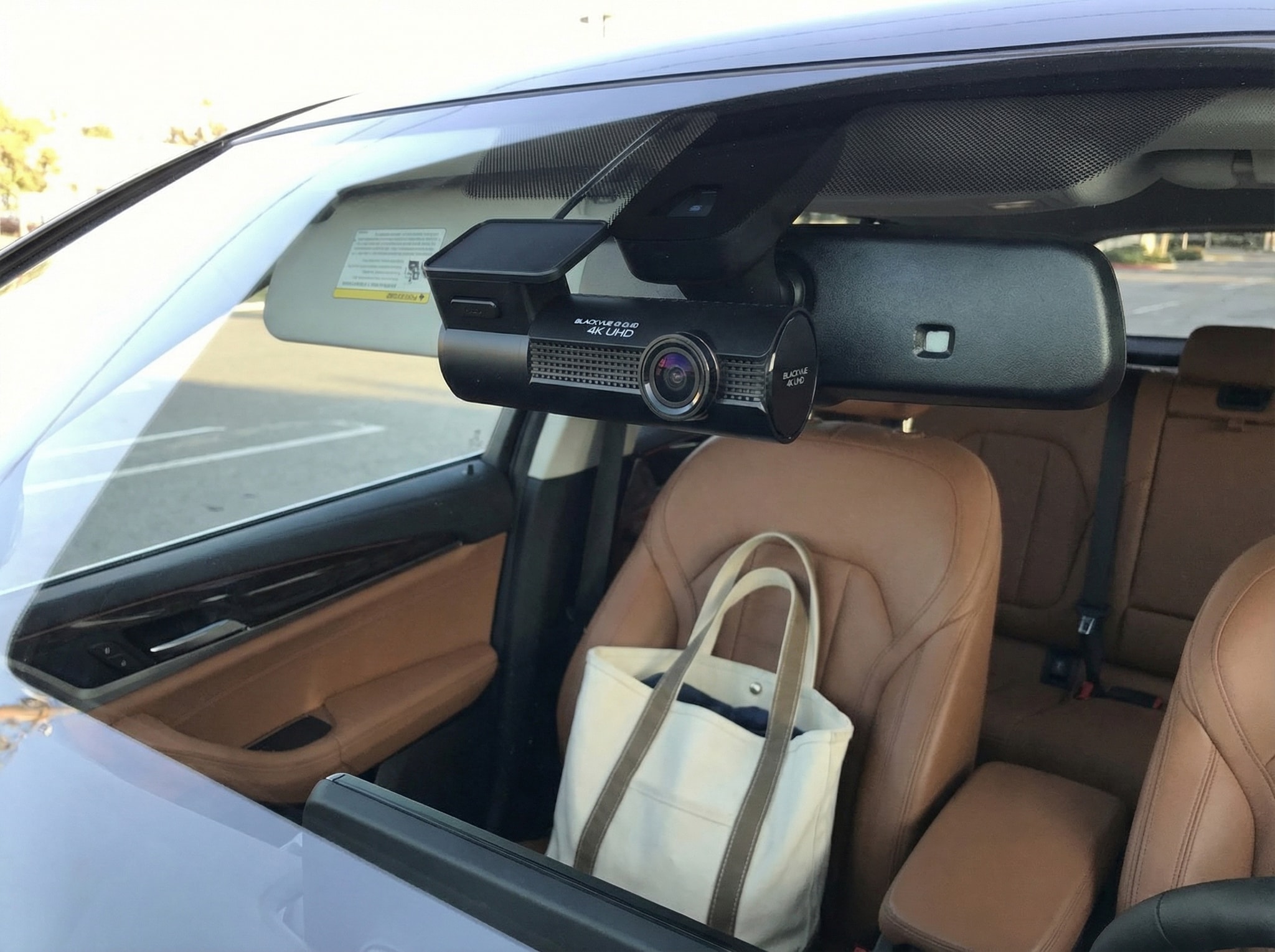
BlackVue's cylindrical form factor has been the brand's visual signature since its early models. The Elite 9 retains it — the front camera is a 130mm cylinder approximately 55mm in diameter, mounting behind the rearview mirror on a magnetic adhesive bracket. The cylindrical design is polarizing: some drivers appreciate its near-invisibility from outside the vehicle; others find it protrudes from the mount more than a wedge-style camera. DashCamTalk members who compared it to the previous DR970X series noted the Elite series is physically slightly larger than its predecessor, though the additional girth improves heat dissipation.
The Elite 9 has no display screen. All configuration happens through the BlackVue app or the BlackVue Viewer PC software. A touch-sensitive area on the camera body triggers manual event recording. An LED indicator shows recording and connectivity status. A built-in speaker provides audio prompts in up to 17 languages. The USB port on the side accepts the optional CM100G LTE module for cloud connectivity, which plugs in without any modification and acts as a mobile Wi-Fi hotspot for up to five additional devices.
Video quality: what 12-bit capture actually means
The Elite 9's headline technical story is its 12-bit capture pipeline. Standard dash cam sensors capture image data at 8-bit color depth — 16.7 million possible color values. The Elite 9's processing pipeline captures at 12-bit (over 68 billion colors), performs noise reduction, HDR blending, and tone mapping at this higher precision, then outputs an 8-bit HEVC file. The practical result is better tonal gradation in the shadows and highlights — areas of the image that look either crushed to black or blown out to white on 8-bit cameras are rendered with more detail and less noise.
The front camera uses an f/1.7 aperture 8-element lens — the fastest aperture of any camera reviewed here. Lower f-number means more light reaches the sensor in low-light conditions without requiring higher ISO gain and the noise that comes with it. The rear camera uses an f/2.0 7-element lens, slightly slower but still class-competitive. Both lenses are described as multi-layer coated to reduce flare and ghosting from oncoming headlights.
DashCamTalk's detailed review rated front camera day quality as very good and night quality as good — a meaningful step up from the DR970X predecessor. Vortex Radar's sample footage comparison showed the Elite 9 producing results comparable to the Viofo A329S and Vueroid S1 4K — the two cameras that had previously defined the quality ceiling for dash cam footage. This does not mean the Elite 9 is equal to the A329S in absolute terms (the A329S's 60fps at 4K is still unique), but it closes the gap sufficiently that the trade-off is no longer obvious.
HEVC compression: more footage per gigabyte
HEVC (H.265) compression is more efficient than the H.264 used in most competing cameras. At equivalent visual quality, HEVC produces smaller files. On a 256GB card at the Elite 9's quality settings, you get approximately 10 hours of footage versus 7-8 hours for an H.264 camera at comparable bitrate. The Elite 9 also supports AVC (H.264) if compatibility with older video players is needed.
Parking mode: weeks of standby on a car battery
The Elite 9's Power Saving Mode draws under 1mA in standby — a specification that BlackVue tested and DashCamTalk's member rcg530 independently verified in his detailed power consumption testing published in December 2025. To put this in context: a typical car battery stores 50 to 80 amp-hours of usable charge. At 1mA draw, the camera would theoretically run in standby for 50,000 to 80,000 hours — over five years — before the battery drained. In practice, real-world parasitic draws, battery self-discharge, and temperature effects reduce this, but the 30-day standby claim is credible and verified.
When an impact is detected by the G-sensor, the Elite 9 wakes in under one second and begins recording, including a 10-second pre-impact buffer. The motion detection parking mode runs at a higher power draw — typically 150-300mA during motion events — but the camera reverts to the low-power state between events. The time-lapse parking mode records one frame per second continuously, creating a compressed record of activity around the vehicle over an extended period at minimal storage cost.
Unlike older BlackVue models, the Elite 9 does not support motion-based entry and exit from parking mode (where the camera automatically switches into parking mode when the car stops moving). This feature was removed from the Elite series and was discussed at the SEMA 2025 event; BlackVue confirmed they are evaluating whether to restore it via firmware update. For most users this is not a critical omission, but users coming from the DR900S or similar should note the change.
BlackVue Cloud: the most mature connected dash cam platform
The BlackVue Cloud platform, running on AWS infrastructure, provides the most comprehensive set of connected features available in the consumer dash cam market. With the CM100G LTE module connected, the Elite 9 maintains a permanent 4G internet connection that enables all of the following:
- Remote Live View — watch your car's surroundings in real time from anywhere via the app
- Push Notifications — immediate alert with a screenshot when an impact or motion event is detected while parked
- GPS Tracking — real-time vehicle location visible on the app map; location retained in the footage timeline
- Automatic Event Upload — impact and motion clips are automatically uploaded to cloud storage without requiring manual intervention
- Two-Way Voice — speak to or listen to whoever is in or near the vehicle through the camera's built-in microphone and speaker
- Geofencing Alerts — notification when the vehicle leaves a defined geographic area (useful for fleet managers and parents tracking young drivers)
The free BlackVue cloud tier provides 5GB of storage for event files and basic push notifications. The paid plans (Lite and Standard) provide more storage, extended event retention, and fleet management features through the FLEETA platform. The CM100G LTE module also serves as a mobile Wi-Fi hotspot for up to five devices, which may offset its cost for users who currently pay for a separate car hotspot.
One practical note from DashCamTalk community testing: the BlackVue app is online-first and requires an internet connection to start up properly. The Thinkware app, by comparison, works fully offline. For users in areas with intermittent connectivity, this occasionally causes app startup delays. Firmware update 1.004 improved cloud connection stability for certain carrier configurations.
Firmware and reliability: a new platform maturing quickly
The Elite 9 launched with firmware v1.001 in November 2025. By March 2026, the camera was on firmware v1.007. That update cadence — seven releases in four months — reflects both active development and a platform still ironing out early issues. The significant resolved issues include: live streaming connectivity problems (fixed in v1.003), GPS reception instability with the older CM100LTE module (fixed in v1.004), and video quality improvements specifically for night recording (added in v1.005).
BlackVue's responsiveness on these issues was consistently praised by DashCamTalk community testers. The company communicated through firmware changelogs, responded to specific user-reported bugs within days, and in several cases shipped beta firmware to affected users before public release. For a new platform launching in late 2025, this support posture is notably stronger than competitors typically manage.
The remaining quirks as of Q1 2026 include occasional app disconnects when closing the app on some phone models (not consistent), and the inability to completely disable the battery cutoff protection feature — a frustration for users running external battery packs who want full control over the camera's power state.
Should you buy the BlackVue Elite 9-2CH?
Buy it if: Remote monitoring is a genuine requirement for you — checking your car while it is at an airport, tracking a teen driver, managing a small fleet, or simply having push notifications when something bumps your vehicle while parked. You are willing to invest in the LTE module to unlock the full cloud ecosystem. You want best-in-class warranty coverage (2 years). You value HEVC compression for efficient storage at high quality.
Skip it if: You do not need cloud connectivity — the Viofo A329S delivers better 4K footage (60fps vs 30fps) for $65 less. You are on a budget — the Vantrue E1 Pro gives you 4K STARVIS 2 for $129. You need a screen on the camera for settings access without pulling out your phone.
The Elite 9-2CH represents a genuine inflection point for BlackVue. For the first time, the brand is competitive on footage quality while retaining its cloud connectivity leadership. The combination is unique in 2026, and for the specific buyer who needs both, nothing else delivers it.
Sources: Vortex Radar DashCamTalk thread (Dec 2025), DashCamTalk Elite 9 review page (Feb 2026), rcg530 power consumption test thread (Dec 2025), BlackVue SEMA 2025 announcement, DashCamTalk Elite 9 firmware threads (Nov 2025-Mar 2026).