Why three independent reviewers picked the same camera
In January 2026, Vortex Radar published his annual dash cam rankings after testing 13 cameras on real roads in Washington State. Wirecutter published their updated guide the same month. DashCamTalk's community expert guide went up two weeks later. All three named the same camera: the Viofo A329S.
That kind of consensus is rare in a market this fragmented. Most categories have legitimate disagreements between expert reviewers. The Viofo A329S has essentially closed the argument for 2026. The question this review answers is not whether to buy it, but whether the specific features that make it the benchmark matter to your driving life — and what you give up to get them.
Design and build quality: honest but functional
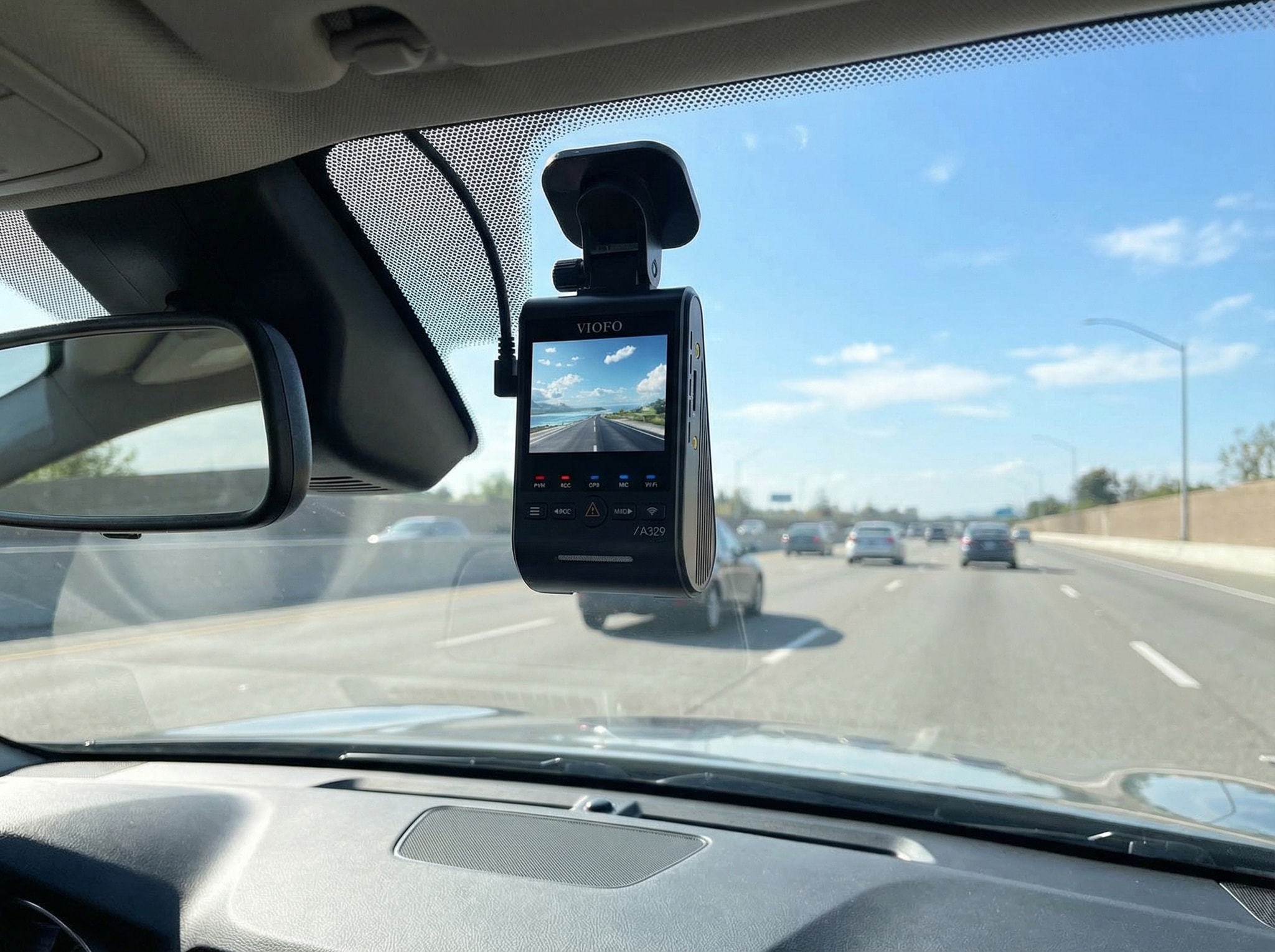
The A329S looks like a refined version of the A329 that preceded it, because it essentially is. The main camera unit is a compact wedge that mounts flush against the windshield with a low profile that does not intrude into the driver's sightline. The 2.4-inch built-in display is small enough to ignore in normal use but large enough to check footage without pulling out a phone.
The build quality is the one area where reviewers consistently note a disconnect between price and feel. AutoEvolution's tester described the plastic construction as not feeling as premium as a camera priced near $500 should. This is fair. The A329S is engineered from the inside out — every dollar went into the sensor, processor, and parking mode architecture rather than the housing material. Whether that trade-off bothers you depends on whether you are buying a gadget or buying a safety tool.
The coaxial rear cable design deserves specific mention. At 2.8mm diameter, it is substantially thinner than the standard micro-USB cables used by competing cameras, making it easier to route through headliners and along door frames invisibly. It also reduces electromagnetic interference with infotainment systems — a documented complaint with cheap cable designs on cameras running near modern car audio and navigation systems. The front unit includes a CPL polarizing filter already attached to the lens, which eliminates the windshield glare that ruins otherwise good footage on competing cameras.
Video quality: best-in-class by a meaningful margin
The Sony STARVIS 2 IMX678 sensor in the front camera captures 4K at 60 frames per second in standard recording mode. This is the technical specification that separates the A329S from the field. Most 4K cameras, including the BlackVue Elite 9-2CH reviewed separately on this site, record at 30fps. The extra 30 frames per second means two things in practice: smoother footage that is easier to scrub through, and the ability to slow clips to half speed while retaining usable resolution. That second point matters when you are trying to read a license plate on a vehicle that was in frame for under a second.
Dashboard Camera Reviews awarded the A329S the highest video quality score of any three-channel dash cam tested in 2025, at 3.8 out of 5. The front camera's natural color science — slightly warmer than the cooler, more clinical output of some competitors — produces footage that is easier on the eyes for long review sessions.
The 60fps vs. HDR trade-off
The A329S cannot simultaneously run 4K 60fps and HDR on the front camera — enabling HDR drops the front camera to 30fps. In practice, most testers run HDR enabled at 30fps for daily mixed-light driving and switch to 60fps for highway use where plate capture is the priority. The rear camera runs 2K HDR at 30fps in all configurations without compromise.
Night performance benefits directly from the STARVIS 2 IMX675 sensor on the rear. The 2.5x wider dynamic range compared to the original STARVIS handles the high-contrast scenario of headlights behind you against a dark background — the single most common failure mode for rear cameras in dark conditions.
The hybrid parking mode: solving the battery drain problem
Standard hardwired parking modes draw between 150mA and 400mA continuously from your vehicle's battery. Leave a car with a standard parking-mode camera parked for five to seven days and you will return to a dead battery. This is the single most common complaint across every dash cam forum and review thread. It has prevented many drivers from enabling parking mode at all, which defeats the purpose of having the feature.
The A329S's hybrid parking mode addresses this at the hardware level. The mode works in two phases. In the first phase, the camera records continuously in time-lapse or low-bitrate mode, drawing normal parking mode current. After a user-configurable timer, it transitions to phase two: an ultra-low-power standby state drawing under 1mA — roughly 150 times less than a standard parking mode. In this state, only the G-sensor stays active. When an impact is detected, the camera wakes in under one second and records the event, including a 10-second pre-impact buffer from the G-sensor's memory. After the clip is saved, it returns to standby.
This requires the HK6 hardwire kit ($26 extra), which continuously monitors battery voltage via Bluetooth and displays the reading in the video overlay. The HK6 also includes a physical hardware voltage cutoff switch as a failsafe, independent of the software cutoff setting. Users in r/dashcam who tested the hybrid mode reported leaving cars parked for over three weeks without battery issues — a result that was simply not possible with previous parking mode implementations.
Wi-Fi 6 and SSD storage: future-proofed for large files
The A329S is the first Viofo camera to ship with Wi-Fi 6, and the difference over Wi-Fi 5 is immediately practical. A one-minute clip recorded at 4K 60fps (89Mbps bitrate) generates a roughly 640MB file. Over Wi-Fi 5, downloading that to a phone takes approximately 90 seconds. Over the A329S's Wi-Fi 6 connection at 30MB/s, the same download takes under 25 seconds. For a driver who regularly reviews footage, this removes one of the most friction-prone aspects of dash cam ownership.
SSD support up to 4TB is the other storage story. At 60fps 4K recording, a 512GB microSD card fills in approximately 9.5 hours. With a 4TB SSD connected via the optional USB-C cable, the same camera stores over 76 hours of continuous high-bitrate footage before loop recording begins. For road-trippers, long-haul drivers, or anyone who wants to review a full week's driving without managing card swaps, this changes the operational model of the camera fundamentally.
Three-channel configurations: one system, four cameras
The A329S's second and third channel accept a wider range of add-on cameras than any other model tested. The default 3CH configuration pairs the main front unit with a standard 2K rear camera and a 2K fisheye interior camera with four infrared LEDs. The fisheye interior camera is the A329S's most distinctive add-on: its 210-degree field of view captures both the passenger cabin and out through the side windows simultaneously — covering essentially everything inside and around the vehicle.
For specific use cases, Viofo offers two alternative second/third camera options. The telephoto camera (35-degree FOV) is designed for license plate capture at distance — useful for drivers in urban environments where vehicles are frequently at low speed and close range. The waterproof exterior rear camera allows mounting outside the vehicle, which matters for trucks and vans without a rear window through which to shoot. Any two-camera combination from this range works in a 3CH setup. A user running the telephoto and waterproof rear simultaneously has both close-range plate capture and exterior rear coverage without an interior camera — a genuinely different coverage profile than any fixed two-camera system.
Installation: plan for an hour
The A329S is not a 15-minute install. Running the rear camera cable along the headliner and down the A or C pillar, routing the front camera cable to the fuse box via the HK6 hardwire kit, and hiding all connections takes most users 45 to 90 minutes on a first installation. The included push/pry tool helps with trim removal, and the coaxial cable's thin diameter makes it easier than most competitors to route invisibly.
Once installed, the system is effectively invisible. The front unit sits behind the rearview mirror. The miniature connectors on the sides of the main unit are clearly labeled rear and interior. The VIOFO app handles all settings configuration and live preview for camera angle adjustment without requiring physical button presses. Over-the-air firmware updates via the app were added in the V2.0 update released earlier in 2026, which eliminates the previous requirement to flash firmware via microSD card swap.
App and connectivity: powerful but not effortless
The VIOFO app handles live preview, settings, firmware updates, and footage download. It is comprehensive and functional. It is not polished in the way the Garmin Drive app is. Multiple reviewers including TechGearLab and autoevolution note that the menu structure is dense and not immediately intuitive for first-time users. The Bluetooth remote ($20 extra) provides three programmable buttons for common functions — locking footage, toggling audio, and switching Wi-Fi — and reduces the need to interact with the app during driving significantly.
The PC player available from Viofo's website allows reviewing footage with GPS overlays on a desktop map, which is substantially more practical than phone-screen viewing for detailed incident analysis.
Should you buy the Viofo A329S?
Buy it if: You want the best possible footage quality in 2026. You park in one location for multiple days at a time and need parking protection without battery anxiety. You want a system that can grow from two cameras to three without buying a new unit. You are comfortable with a 45-90 minute installation and do not need remote monitoring.
Skip it if: You need cloud connectivity and remote monitoring — the BlackVue Elite 9-2CH is the right answer. You want something that installs in 15 minutes — the Vantrue E1 Pro is better for that use case. Your budget is under $300 — the Vantrue N5S is a better allocation of money if you need multi-channel coverage.
For the driver who has decided to buy a premium local-storage dash cam and wants the best of that category, the A329S has no real competition in 2026. The consensus among the three most credible independent testers in the segment is not accidental — this camera earns it.
Sources: Vortex Radar (Jan 2026), DashCamTalk buyer's guide (Jan 2026), Dashboard Camera Reviews (Nov 2025), AutoEvolution (Mar 2026), Tom's Guide (Dec 2025), The Gadgeteer (Aug 2025).