The camera that resets expectations for under $150
In February 2025, Vantrue released a compact front-only dash cam with a Sony STARVIS 2 IMX678 sensor, true 4K recording at 30fps, a built-in CPL filter, GPS, 5GHz Wi-Fi, and buffered parking mode — all in a body roughly the size of a large postage stamp — for $149.99, frequently discounted to $129. Within three months of release, CNET named it their Best Overall Dash Cam pick. DashCamTalk reviewed it and concluded it delivers real 4K at a price point that makes comparable wedge-shaped competitors costing $180 to $290 difficult to justify.
The E1 Pro is not without documented problems. It runs hot. Multiple independent reviewers across TechRadar, Tom's Guide, autoevolution, and DashCamTalk's community flagged the body temperature issue consistently. Vantrue guarantees operation in extreme temperatures, but the heat generated by the camera itself during recording is a distinct concern — one that has unknown implications for long-term component life. This review addresses both sides: why the E1 Pro is the best value in its category, and precisely what you are accepting when you buy it.
Design: small enough to disappear, with a screen
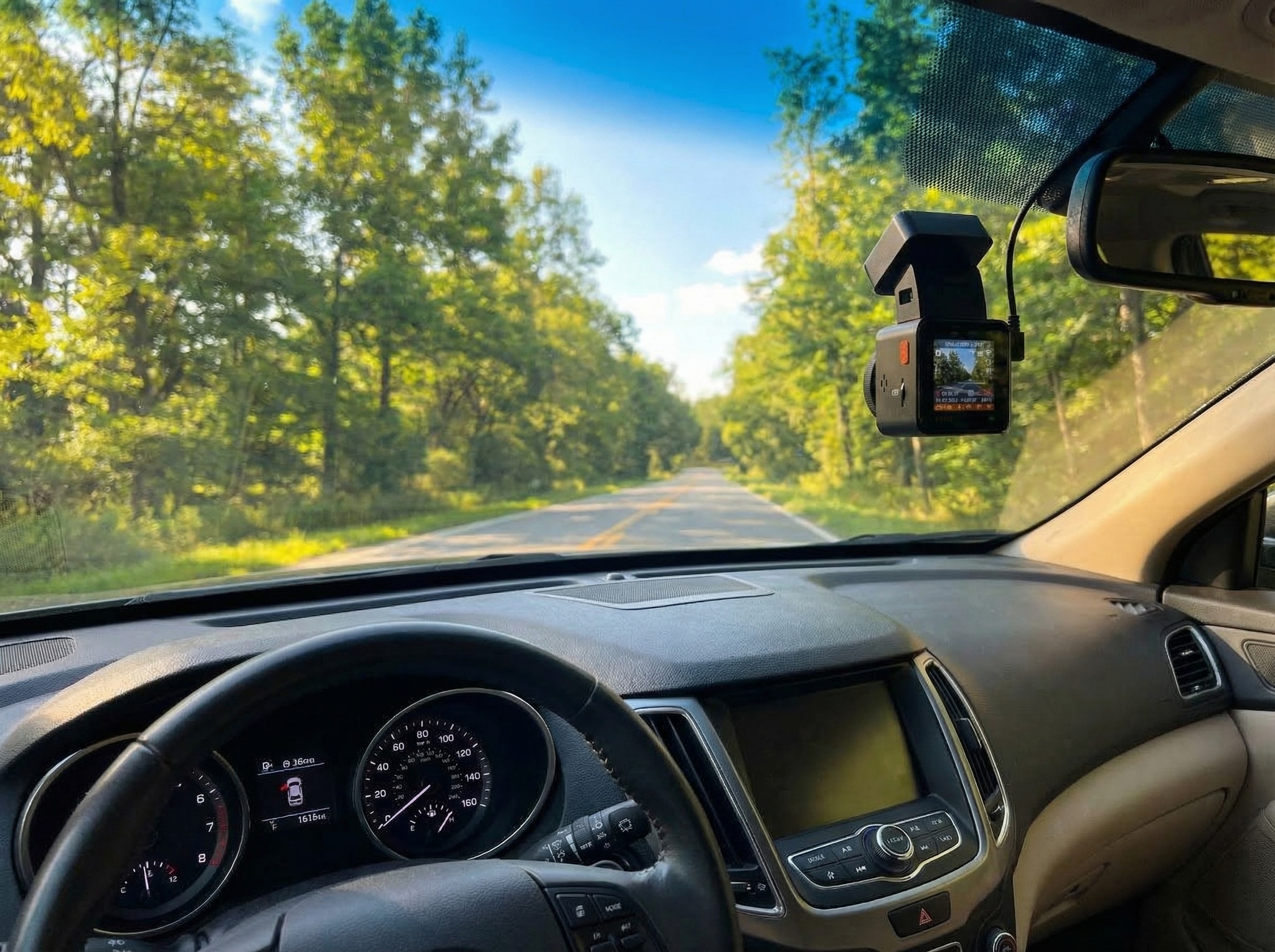
The E1 Pro is approximately cube-shaped at 1.97 x 1.73 x 1.73 inches. Dashboard Camera Reviews measured its exact dimensions and noted it is slightly deeper than it is tall or wide — a design choice that allows a reasonable-sized lens assembly while keeping the height profile minimal. Mounted on the windshield behind the rearview mirror, the E1 Pro sits almost entirely within the mirror's shadow zone, making it effectively invisible from the driver's seat and from outside the vehicle.
Unlike the Garmin Mini 3, which sacrificed a screen entirely for size, the E1 Pro includes a 1.54-inch IPS LCD on the rear face. This screen is small — DashCamTalk's reviewer described it as crammed with icons and somewhat difficult to navigate via the three small buttons on the side. In practice, most users configure the camera once through the app and then leave the screen dormant. The screen proves most useful during initial installation for verifying camera angle. The auto-off timer can be set to as low as 30 seconds for drivers who do not want the screen on during use.
The magnetic adhesive mount is a design choice that separates the E1 Pro from most competitors. The camera snaps onto the mount magnetically and can be removed in one motion without tools. This makes it practical to move between vehicles or remove from the windshield for security in unfamiliar parking locations — a genuine usability advantage over cameras that require unscrewing a bracket to dismount.
Video quality: what real 4K STARVIS 2 looks like at $129
DashCamTalk's review explicitly called out that the E1 Pro delivers real 4K, distinguishing it from the many cameras that market 4K resolution but achieve it through sensor interpolation or software upscaling. The Sony STARVIS 2 IMX678 is a native 8-megapixel sensor that records at 3840x2160 pixels without artificial enhancement. At 30fps and approximately 32Mbps average bitrate, the footage quality is very good in daylight and good at night — DashCamTalk's ratings for both.
TechRadar's reviewer called the footage crisp and clear, and praised the 158-degree field of view as offering an expansive view of the road without the barrel distortion that plagues some ultra-wide cameras. This wider angle than the 140-degree Viofo A329S front camera captures more of adjacent lanes and roadside pedestrians — useful for urban driving where threats come from multiple angles.
PlatePix HDR: useful but requires tuning
Vantrue's PlatePix mode processes the image to prioritize license plate clarity, claiming a 50% improvement over standard 4K HDR. Tom's Guide's reviewer tested PlatePix and noted that it does improve plate readability but makes the overall image darker. autoevolution's reviewer confirmed this: enabling PlatePix requires manually increasing brightness to maintain overall exposure quality. The default settings optimize for standard HDR; PlatePix is best used at night specifically for plate capture, with a compensating brightness adjustment. Left at default, PlatePix at night creates footage where dark vehicles are difficult to distinguish. With brightness adjusted, it genuinely improves plate legibility on moving vehicles.
Night performance and thermal interaction
The camera's heat generation may interact with its night recording performance. In cooled conditions (air conditioning running, cooler outdoor temperatures), night footage quality is strong. In heated conditions — an enclosed car in direct summer sun — the sensor running hot may introduce additional noise in night recordings. This is a hypothesis based on the documented heat issue; no controlled testing data comparing E1 Pro night footage quality by temperature is publicly available as of Q1 2026.
The heat issue: documented, real, and what it means for your purchase
Every independent reviewer of the Vantrue E1 Pro 4K reached the same finding: the camera runs hot. TechRadar noted it runs extremely hot during operation, even with the display in sleep mode. Tom's Guide observed it running noticeably warm. autoevolution's tester confirmed it tends to overheat during hot sunny days. DashCamTalk's comprehensive review summary states directly: the camera runs hot, so longevity is unknown.
Vantrue's response has been to note that the supercapacitor design means the camera can withstand extreme external temperatures (guaranteed to operate in high heat environments), and that the camera uses an internal thermal management system. This addresses the question of whether the camera survives being parked in a hot car — it should. It does not address the question of whether the heat generated by the camera itself during continuous recording accelerates component aging.
The practical implications depend strongly on your use case:
- Occasional use / moderate climate: The heat issue is unlikely to affect reliability in a meaningful way. Users in temperate climates who drive daily but park in covered parking will see fewer thermal stress cycles than worst-case scenarios.
- Daily continuous recording / hot climate: If you park in direct summer sun in Arizona, Texas, or similar climates, and the camera is recording via parking mode for hours before you return to the vehicle, the combined heat from the environment and the camera's own operation represents a more significant unknown. The camera has only been on the market since February 2025, so two-plus-year field data in these conditions does not yet exist.
The honest buyer's framework: at $129, the E1 Pro is priced for a shorter replacement cycle than a $429 Viofo A329S. If the camera lasts three years of daily use in a moderate climate, the cost-per-year math is favorable even accounting for a potential early replacement. If long-term reliability over five or more years matters more than upfront cost, the A329S or BlackVue Elite 9 are safer investments.
Parking mode, app, and connectivity
The E1 Pro's buffered parking mode records 15 seconds before motion detection triggers and 30 seconds after. This pre-buffer is stored in the camera's G-sensor memory and combined with the post-event recording into a single saved clip. For common parking incidents — a car brushing your bumper while squeezing into a tight space, someone opening their door into your car, a shopping cart rolling across the lot — this 15-second pre-buffer is the crucial footage that shows what led to the contact.
Parking mode requires a hardwire kit to maintain power when the ignition is off. Vantrue sells a compatible hardwire kit for approximately $20. Without it, the E1 Pro only records while the car is running. An optional Vantrue LTE module ($149) adds remote monitoring capability similar in concept to the BlackVue cloud — Live View, notifications, and GPS tracking via the Vantrue app — but this nearly doubles the total investment and changes the price calculation significantly.
The Vantrue app connects via Wi-Fi for local access and handles settings, firmware updates, and footage download. The 5GHz connection downloads a one-minute 4K clip in approximately 30 seconds (at the 8MB/s rate). The app is functional and praised by most reviewers as clean and intuitive, particularly compared to the E1 Pro's on-camera screen interface. Firmware updates are available OTA through the app.
How it compares to alternatives
The E1 Pro's most direct comparison is the Garmin Dash Cam Mini 3 ($149). The Mini 3 is smaller, has a better-branded app experience, and carries Garmin's reputation for long-term reliability. But it records at 1080p versus the E1 Pro's 4K, has no GPS, and has no rear camera option. In 2026, choosing 1080p over 4K STARVIS 2 requires a specific justification — the Garmin Mini 3's size advantage is real but does not compensate for the resolution gap for most buyers.
The Viofo A119 Mini 2 ($149) is the community-recommended alternative from a brand with a proven multi-year reliability track record. It records at 2K rather than 4K, using a Sony STARVIS 2 IMX675 sensor. DashCamTalk recommends it as the best budget compact. Against the E1 Pro, it trades 4K resolution for a brand reliability record that spans years of community testing. For buyers where the E1 Pro's heat concern is a deciding factor, the A119 Mini 2 is the rational alternative.
Should you buy the Vantrue E1 Pro 4K?
Buy it if: You need a front-only compact with true 4K STARVIS 2 quality and your budget is under $150. You understand and accept the heat issue as a trade-off. You drive in a moderate climate or covered parking. You are willing to replace the camera earlier than a premium unit if the thermal stress shortens its life. You want the maximum features per dollar in 2026.
Skip it if: Long-term reliability over five or more years is a priority. You park in extreme summer heat with prolonged parking mode use. You need a rear camera — the E1 Pro has no rear camera option at all. You drive professionally or need commercial-grade documentation.
At its current price, the Vantrue E1 Pro 4K is the most feature-dense sub-$150 compact dash cam on the market. CNET's Best Overall verdict is defensible. DashCamTalk's longevity caveat is equally honest. Both things are true simultaneously, and this review presents them that way.
Sources: CNET Best Overall designation, TechRadar E1 Pro review (Apr 2025), Tom's Guide E1 Pro review (Apr 2025), autoevolution E1 Pro review (Aug 2025), DashCamTalk E1 Pro page (Dec 2025), DashCamTalk community review by Hackman, Dashboard Camera Reviews E1 Pro review.