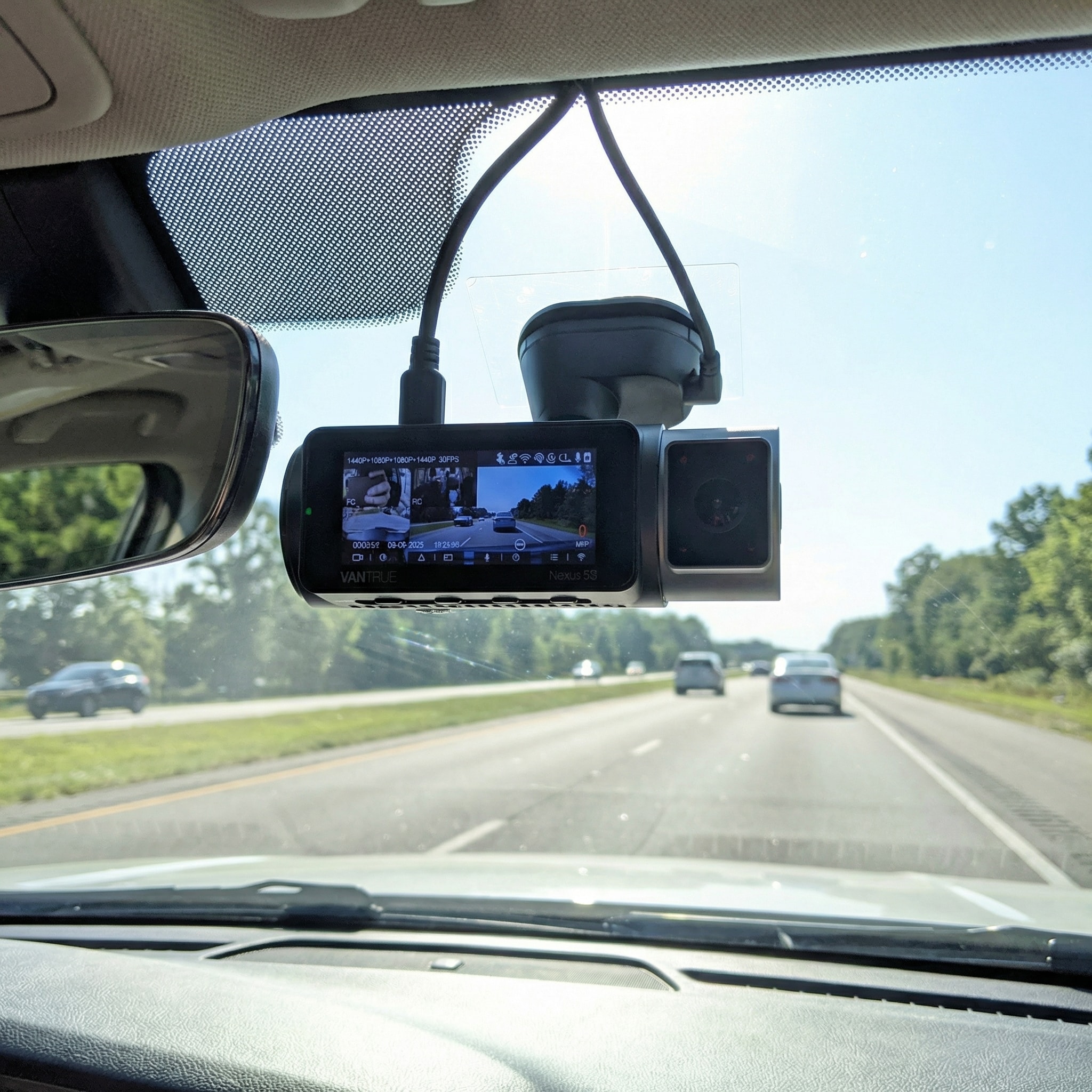
When your car is your office
Most dash cam reviews are written for personal drivers who want protection against accidents and parking incidents. The Vantrue N5S is not designed for that buyer. It is designed for drivers who spend eight or more hours a day in their vehicle as a workplace — rideshare drivers, taxi operators, delivery professionals, and fleet vehicle operators — where documentation requirements are fundamentally different.
A personal driver needs evidence of what happened in front of and behind the vehicle. A rideshare driver needs evidence of what happened inside the vehicle as well. A passenger dispute, a false damage claim, an alleged inappropriate interaction — these incidents happen in the cabin, and a single wide-angle interior camera that turns indistinct at night does not provide the documentation that holds up in a complaint review. The N5S provides two independent interior cameras, each covering one side of the front cabin with infrared night vision, resolving this gap at a price no competitor comes close to matching.
DashCamTalk's January 2026 buyer's guide identifies the N5S as the top pick for rideshare drivers specifically because of the dual interior camera quality. This review examines why that conclusion holds and what the N5S gives up to deliver it.
Design and installation: plan for two hours
The N5S main unit is larger than single or dual-channel competitors — it needs to house four camera ports, a 3-inch touchscreen, and the processing hardware for four simultaneous recording channels. The unit mounts on the windshield with an adhesive bracket behind the rearview mirror, though its size means it protrudes further into the driver's sightline than a single-channel camera. In SUVs and larger sedans this is rarely an issue; in smaller hatchbacks and coupes, positioning requires more care.
The four-channel cable routing is the real installation challenge. The front camera is built into the main unit. The rear camera requires a long cable run (typically 5-6 meters) from the front to the rear windshield. The two interior cameras mount on the headliner or A-pillar, with cables running to the main unit. Running all four cables cleanly through headliner channels and pillar trim takes most experienced installers 90 minutes to two hours. Vantrue includes a pry tool for trim removal. First-time installers should budget closer to three hours.
Once installed and hardwired, the N5S requires no ongoing maintenance. The 3-inch touchscreen allows all settings, parking mode configuration, and footage review directly on the camera without requiring a phone. For professional drivers who may not always have their personal phone accessible during a shift, this is a practical advantage over app-only cameras.
Exterior video quality: 4K front and rear at 170 degrees
The N5S records 4K at 30fps from both the front and rear cameras, using Sony STARVIS 2 sensors on each. The 170-degree field of view is the widest of any camera in this review — 30 degrees wider than the Viofo A329S front camera. In urban and suburban driving, this captures more of the adjacent lanes and roadside environments, potentially including pedestrians and cyclists that a narrower camera would miss at the edges of the frame.
The front camera does not have HDR. This is the most significant video quality limitation versus the Viofo A329S and BlackVue Elite 9. In high-contrast scenes — driving toward a low sun, exiting a tunnel into bright daylight, or trying to read a license plate on a vehicle silhouetted against bright headlights — the A329S's front HDR preserves detail in both highlights and shadows simultaneously. The N5S front camera chooses one or the other based on its exposure algorithm. For most driving scenarios this is not a critical limitation; for license plate capture in challenging backlit conditions, it is a genuine gap.
The rear camera includes HDR, which handles the common scenario of headlights from following vehicles better than a non-HDR rear camera. Night footage from the rear is solid and practically useful for identifying following vehicles.
The dual interior cameras: the N5S's defining feature
The N5S includes two interior cameras mounted to cover the front cabin: one angled toward the driver seat and one angled toward the passenger seat. Each is equipped with infrared LEDs that illuminate the cabin in the near-infrared spectrum, producing clear footage even in total darkness. This is the hardware specification that separates the N5S from every other four-channel system at its price point — and from most systems at any price.
Single interior cameras, even wide-angle ones, have an inherent problem in covering a full car cabin: at the angle needed to see both driver and passenger, the resolution allocated to each is diluted, and low-light performance deteriorates at the image edges. The N5S dedicates a full camera to each front seat position. The driver camera captures the driver's hands, face, and any interactions at the driver's window. The passenger camera captures the passenger's behavior, the passenger door area, and the passenger seat environment independently. In a rideshare dispute where a passenger makes a claim about driver behavior — or vice versa — having two independent camera angles covering each party is a fundamentally different evidentiary position than a single ambiguous wide shot.
DashCamTalk's testing noted the N5S's interior camera performance is exceptional for its price category — specifically the full-color capability in nighttime conditions. In well-lit urban environments at night, the IR LEDs produce footage that shows color, not just the grey scale typical of IR cameras. This further improves the evidentiary value of interior footage in a dispute context.
AI driver assistance and 1TB storage
The N5S includes an AI driver assistance system with four active features: forward collision warning, lane departure alert, blind spot detection, and pedestrian detection. For personal drivers who already have these systems built into their modern vehicles, these are redundant. For rideshare and commercial drivers in older vehicles — the demographic most likely to buy the N5S — they provide alerts that were previously available only in newer cars.
Forward collision warnings catch micro-drowsiness moments during extended shifts when the driver's reaction time degrades slightly. Lane departure alerts flag the kind of gradual lane drift that accumulates on long highway segments. Blind spot detection covers the passenger-side blind spot that remains a consistent urban accident contributor. Pedestrian detection triggers in low-speed urban environments where pedestrians and cyclists are most at risk. None of these replace driver attention; all of them add a secondary alert layer during the fatigue-prone later hours of a long shift.
The 1TB microSD support is the most practical specification for professional operators. At 4K 30fps recording across four channels simultaneously, storage fills faster than a single-channel camera. A 1TB card stores approximately 20-25 hours of four-channel simultaneous 4K recording. For a driver who works five-hour shifts five days a week, this means the most recent week's complete footage is available before loop recording begins overwriting it. Operators who need to retain footage following a Monday incident and review it on Friday will find the 1TB headroom genuinely valuable.
Parking mode and connectivity
The N5S buffered parking mode captures pre-impact footage before the trigger event — the same capability as the BlackVue Elite 9 and Viofo A329S parking modes, and meaningfully better than non-buffered parking modes that only record after an impact is detected. Without the pre-buffer, the footage of what caused the impact (a vehicle backing into your car, a door being opened aggressively) is often not captured. With it, the complete sequence from approach to impact is preserved.
The N5S does not have cloud connectivity without a third-party solution. For fleet operators who need GPS tracking or remote monitoring across multiple vehicles, this requires either a separate telematics device or a third-party OBD-II GPS tracker. For individual rideshare drivers, the absence of cloud connectivity is rarely a practical issue — the local footage is available immediately via the Wi-Fi app connection or by pulling the microSD card.
Wi-Fi connectivity is 5GHz standard (not Wi-Fi 6). Clip download speed through the Vantrue app is approximately 4-6MB/s for normal files — slower than the A329S's 30MB/s Wi-Fi 6 connection. For reviewing a single incident clip, this is a minor inconvenience. For bulk downloading a day's footage, it becomes material. Most N5S users review footage on the camera's 3-inch screen or pull the microSD card for computer review rather than downloading to a phone.
Who should buy the N5S — and who should not
The N5S is purpose-built for professional vehicle use. The four-channel STARVIS 2 system, dual interior IR cameras, 1TB support, and AI driver assistance are all features that address professional driver needs specifically. Personal drivers who want the best video quality should consider the Viofo A329S. Personal drivers who want cloud connectivity should consider the BlackVue Elite 9. Personal drivers on a budget who need only front coverage should consider the Vantrue E1 Pro.
The N5S buyer is a professional driver who: needs complete documentation of every passenger interaction, cannot accept the evidentiary gap of a single ambiguous interior camera, requires enough storage to retain a full working week of footage, and benefits from AI driver alerts during extended fatigue-risk shifts. This is a large and growing buyer segment — the rideshare industry alone represents millions of active vehicles in the United States — and the N5S serves it better than any other camera at its price point.
The installation investment is real. Two hours minimum for a clean install is not trivial. But it is a one-time cost. Once the N5S is hardwired and configured, it operates without ongoing intervention. For a professional driver who will use the camera daily for two or more years, the installation cost amortizes quickly against the protection it provides.
Final verdict
The Vantrue N5S is the definitive answer for rideshare drivers, taxi operators, and commercial fleet vehicles in 2026. Four Sony STARVIS 2 channels, independent dual interior IR cameras, 1TB storage, and AI driver assistance at $299 has no competitor within $300 of its price. BlackVue's comparable four-channel systems start above $600; Thinkware's equivalent configurations exceed $700.
For the professional driver for whom this camera is designed, the purchase decision is straightforward. The only consideration is the installation time commitment — which should be viewed as a one-time professional safety investment, not an inconvenience. Buy a quality hardwire kit alongside it, route the cables properly, and the N5S will document everything that happens in and around your vehicle for as long as you are driving professionally.
Sources: DashCamTalk Buyer's Guide (Jan 2026), CNN Underscored testing (2025), Dashboard Camera Reviews N5S review, DashCamTalk N5S community discussion, Vantrue product specifications.